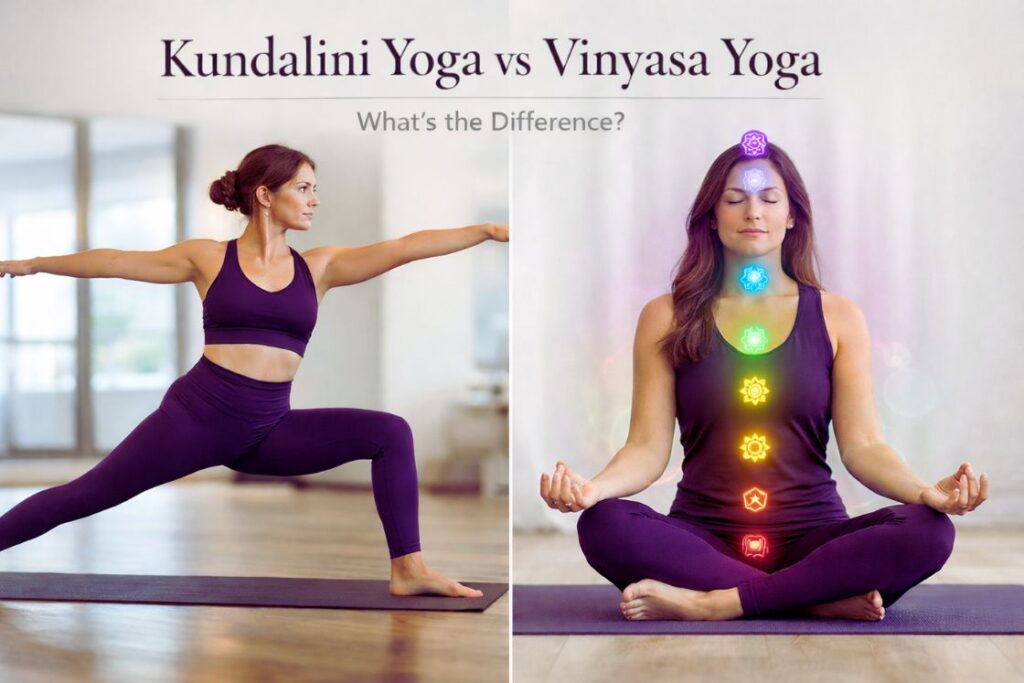
Kundalini yoga and Vinyasa yoga are two practices that often appear in modern yoga studios.
At first glance they sound similar. After all, both have the word yoga in them. But if you attend a class of each, the experience can feel completely different.
One class may have you moving continuously through poses, building heat and strength. Another may move more slowly, focusing on breath, awareness, and meditation.
Both are genuine yoga practices. They simply approach yoga from different directions.
This guide will help you understand the difference so you can decide which one fits where you are right now.
No complicated philosophy. Just a clear explanation of how these practices work.
The quick explanation
The main difference between Kundalini yoga and Vinyasa yoga lies in their focus.
- Vinyasa yoga emphasises continuous movement, linking poses together with the breath to build strength, flexibility, and stamina.
- Kundalini-based yoga practices focus more on breath control, meditation, and internal awareness, aiming to balance the nervous system and develop deeper mental clarity.
While Vinyasa tends to feel like a physical workout, Kundalini-oriented practices often emphasise breathing techniques, meditation, and gradual inner development.
Key differences between kundalini and vinyasa yoga
| Feature | Vinyasa Yoga | Kundalini-Based Yoga Practices |
|---|---|---|
| Primary focus | Movement and physical flow | Breath, awareness, and internal balance |
| Intensity | Physically demanding | Internally focused |
| Sweat level | Medium to high | Usually low |
| Pace | Continuous movement | Slower and more structured |
| Main tools | Yoga poses linked with breath | Pranayama, meditation, mudra, and asana |
| Atmosphere | Active and dynamic | Calm and inward |
| Results often felt | Strength, flexibility, stamina | Mental clarity, calmness, emotional balance |
A little background: where these styles come from
Modern yoga has developed in many directions over the last century.
Vinyasa yoga grew out of modern postural yoga traditions influenced by Tirumalai Krishnamacharya and his students. Dynamic movement-based styles later spread around the world through teachers such as Pattabhi Jois.
Kundalini practices have a different background.
The idea of kundalini energy appears in older yogic and tantric texts, where it describes a latent energy within the human system that can awaken through dedicated practice.
In traditions such as the Bihar School of Yoga, established by Swami Satyananda Saraswati, kundalini is approached gradually through a combination of yogic practices rather than a single class style.
It’s worth noting that in many Western studios the term Kundalini Yoga often refers to a specific system introduced in the late 1960s by Yogi Bhajan.
Traditional yoga schools in India, however, usually teach kundalini-related practices in a slower and more systematic way.
In traditional yoga schools influenced by the Satyananda tradition, kundalini practices are usually introduced gradually as part of a broader yoga practice rather than taught as a single class style.
What happens in a vinyasa yoga class
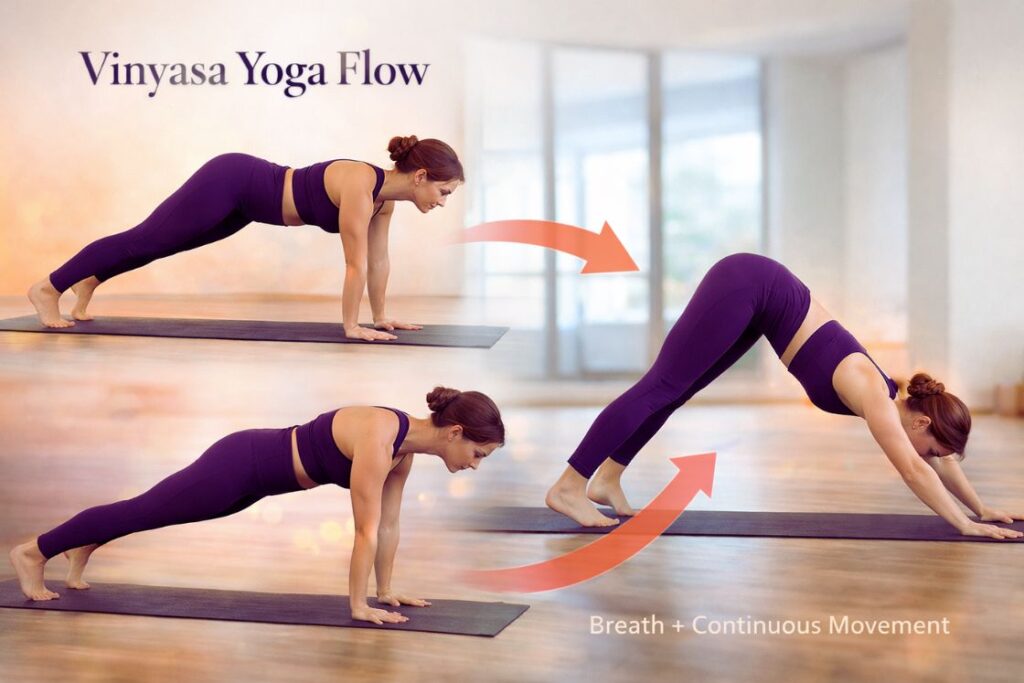
Most people find Vinyasa easy to understand because it looks similar to exercise.
You move. You breathe. You sweat a little. And by the end of the class, your body feels worked.
You don’t need to be flexible
Many beginners worry about flexibility before their first class. The truth is that flexibility develops through practice.
You don’t need to arrive flexible. The practice helps you build it gradually.
A typical vinyasa class
Most classes run between 60 and 75 minutes.
Although each teacher creates their own sequence, the general structure is similar.
- Warm-up
The class usually begins with gentle movement to prepare the body. This might include simple stretches or movements such as Cat–Cow to mobilise the spine.
- The main flow
The middle part of the class is where the pace increases.
You move through sequences of poses such as:
- Downward Dog
- Plank
- Chaturanga
- Warrior poses
The breath guides the movement.
An inhale often opens the body.
An exhale usually folds or grounds the movement.
Because each teacher designs their own sequence, no two Vinyasa classes are exactly the same.
- Cool-down
Toward the end of class the pace slows. You move into deeper stretches for the hips, spine, and legs.
- Savasana
The final minutes are spent resting on the back in Savasana. This allows the nervous system to settle and the body to absorb the practice.
Many beginners say this is unexpectedly their favourite part.
What Vinyasa yoga develops over time
With regular practice, Vinyasa yoga tends to improve:
- muscular strength
- flexibility
- balance and coordination
- cardiovascular fitness
- mental focus
For many people, the biggest benefit is the mental reset that comes after physical effort.
Moving with breath demands attention. By the end of class the mind often becomes quiet simply because it has had something clear to focus on.
What a traditional kundalini-based yoga practice looks like
When people hear the term Kundalini yoga, they often imagine a specific type of class.
In traditional yoga teachings, however, kundalini is not a single style of yoga. It refers to a deeper process within the yogic path.
In yogic traditions, kundalini describes a dormant potential energy believed to exist within the human system.
Because of this, traditional approaches do not rush the process.
Instead, they use a combination of practices that work together over time.
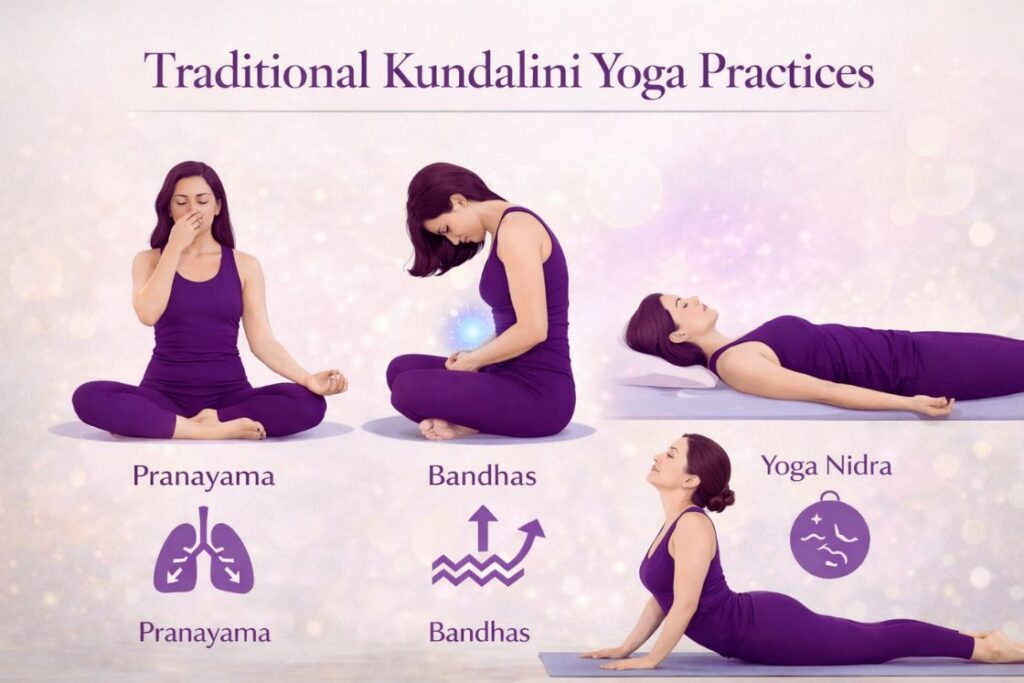
In traditions such as those influenced by the Bihar School of Yoga, the practices that support this process include:
- asana (physical postures)
- pranayama (breathing practices)
- mudra and bandha (energy-directing techniques)
- meditation
- deep relaxation practices such as yoga nidra
Rather than a fixed class sequence, these practices are introduced gradually so the body and nervous system can adapt safely.
Join Our 40-Day Live Tantra Kundalini Yoga Course
A typical structure of this kind of practice
Although every teacher approaches it slightly differently, a traditional session often includes several stages.
1. Preparation through asana
The practice usually begins with a few yoga postures.
These are not performed mainly as physical exercise, but as a way to remove stiffness from the body and prepare the spine.
Gentle forward bends, twists, and spinal movements are commonly used.
The goal is to create a body that can sit comfortably and breathe freely.
Best Yoga Poses for Chakra Balancing
2. Pranayama
Breathing practices are one of the central tools of yoga.
Techniques such as:
are used to influence the nervous system and balance the flow of prana, the life force described in yogic traditions.
These practices can create a noticeable shift in mental clarity and calmness.
3. Mudra and bandha
As the practitioner becomes more experienced, additional techniques may be introduced.
Mudras and bandhas are subtle practices that direct internal energy within the body.
Examples include:
- Maha Mudra
- Moola Bandha
- Jalandhara Bandha
These practices are usually learned gradually under guidance.
4. Meditation
Meditation helps stabilise attention and develop inner awareness.
Sometimes the meditation focuses on the breath.
Sometimes it involves mantra or simple observation of the mind.
Over time, meditation develops steadiness that carries into everyday life.
5. Deep relaxation
Practices such as yoga nidra are often included to integrate the effects of the practice.
Deep relaxation allows the nervous system to settle and can release accumulated physical and mental tension.
Many students find this part surprisingly powerful.
What is Yoga Nidra and it’s four Stages
What these practices do over time
When practiced consistently, these techniques can support:
- better nervous system balance
- improved sleep quality
- greater emotional stability
- increased self-awareness
- a deeper sense of calm and clarity
The changes often appear gradually rather than dramatically.
For many people, the biggest difference is simply feeling more centred in daily life.
How often should you practice?
Vinyasa: 2–3 times per week is a solid starting point. This gives your body time to recover and adapt between sessions, while building momentum.
Kundalini: Even short, daily practice creates a noticeable shift. A 20-minute morning session done consistently is more powerful than a 90-minute class once a week. If you can only do five minutes on some days, do five minutes. Consistency matters more than duration..
Can you practice both?
Yes and it’s actually a powerful combination.
Vinyasa builds the physical foundation: the strength, flexibility, and breath awareness that makes everything else easier.
Kundalini builds the internal foundation: nervous system resilience, the ability to sit in stillness, and an inner steadiness that physical fitness alone doesn’t always provide.
Many people use both in the same week. Vinyasa on the days you need to move and feel strong. Kundalini on the days you need to go inward, reset, or work through something you can’t quite name.
They’re not competing with each other. They’re working on different layers of the same person.
Which yoga should you choose?
Choosing between Kundalini-based practices and Vinyasa yoga depends mostly on what you want from your practice.
You might prefer Vinyasa yoga if you:
- enjoy movement and physical challenge
- want to improve strength and flexibility
- prefer a class that feels energetic and dynamic
- like variety in each session
You might prefer kundalini-oriented practices if you:
- want to develop meditation and breath awareness
- feel mentally stressed or overstimulated
- are interested in the deeper psychological aspects of yoga
- prefer a slower and more reflective practice
Many practitioners eventually explore both approaches, using movement-based yoga for physical health and breath or meditation practices for mental balance.
Final thoughts
There is no single form of yoga that suits everyone.
Some people connect immediately with the rhythm and physical challenge of Vinyasa.
Others discover that slower practices involving breath and meditation bring a deeper sense of balance.
The most important thing is not choosing the “best” style of yoga.
It is finding a practice that you will return to regularly.
Over time, that consistency is what allows yoga to unfold its real benefits.
FAQs
Vinyasa is usually more physically demanding because of continuous movement.
Kundalini-based practices can feel mentally challenging because they involve breath control and meditation.
Both can work for beginners.
People who enjoy physical activity often start with Vinyasa, while those interested in meditation may prefer breath-focused practices.
Vinyasa yoga generally burns more calories because it involves continuous physical movement.
Traditional kundalini practices are connected to meditation and self-awareness, which many people consider part of a spiritual path. However, they can also be practiced simply for mental balance and wellbeing.
Yes. Many people combine both styles. Vinyasa builds physical strength and flexibility, while breath and meditation practices help develop mental focus and relaxation.
Some practitioners are drawn to kundalini-oriented practices because they focus more on breath, meditation, and internal awareness rather than physical movement alone.
The post Kundalini Yoga vs Vinyasa Yoga: Which One Is Actually Right for You? appeared first on Fitsri Yoga.